. After transforming residential rooftops into micro power stations, the Tripura Government has now set its sights on bringing government offices under the ambit of solar-powered electricity generation.
In line with the guidelines of the Ministry of New and Renewable Energy, the state has initiated the installation of grid-connected rooftop solar power plants across all District Magistrate offices under the “Solar Sankalp” initiative.
The responsibility for executing this ambitious project has been entrusted to Tripura State Electricity Corporation Limited (TSECL), the state’s power utility.
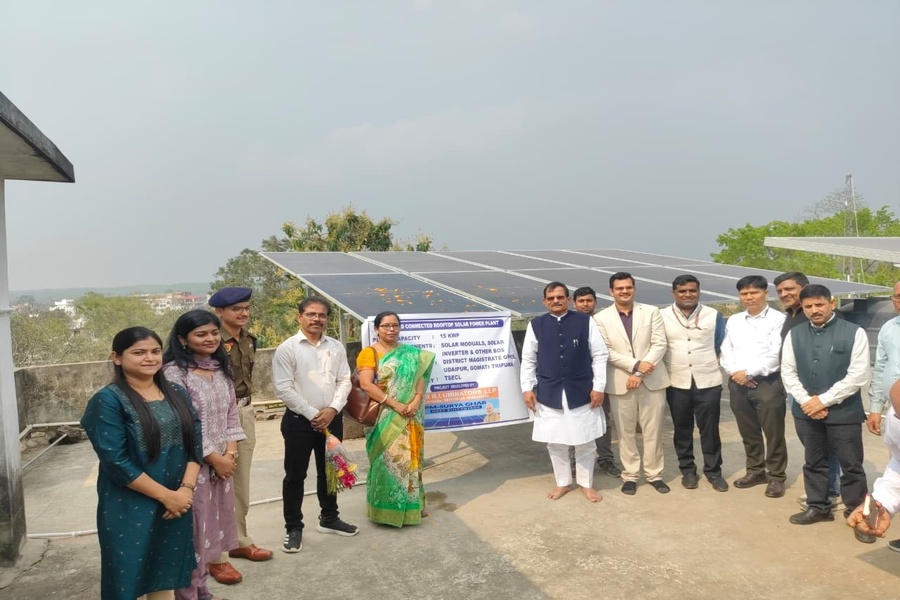
The initiative formally began today afternoon in Udaipur, where Union Minister of State for New and Renewable Energy Shripad Naik inaugurated a 15-kilowatt grid-connected rooftop solar power plant at the Gomati District Magistrate’s office. The event was attended by Gomati District Magistrate Rinku Lather, IAS; Additional General Manager of TSECL (Gomati) Nandita Das; and Sanjeeb Nandy Majumdar, the state’s nodal officer for the PM Surya Ghar Muft Bijli Yojana, along with engineers and senior officials associated with the project.
Addressing the gathering, Shripad Naik underscored that solar energy is set to become the central pillar of India’s future energy landscape.
He noted that integrating government offices into the solar energy framework is not merely about reducing electricity bills; it represents a structural shift toward environmentally responsible governance. According to him, Tripura’s initiative marks a significant milestone in implementing the Union Government’s renewable energy vision at the grassroots administrative level.
Notably, Gomati is the first district in the state where the project has been commissioned. According to sources in TSECL, rooftop solar plants with a combined capacity of 304 kilowatts will be installed across eight district magistrate offices in Tripura, at an estimated cost of Rs 2.43 crore.
Apart from the 15-kilowatt plant in Gomati, installations are planned as follows: 49 kilowatts in Sepahijala, 35 kilowatts in South Tripura, 90 kilowatts in North Tripura, 15 kilowatts in Khowai, 22 kilowatts in Unakoti, 25 kilowatts in Dhalai, and 53 kilowatts in West Tripura. Once operational, these systems will directly meet a substantial portion of each office’s energy demand through clean, renewable power.
State Power Minister Ratan Lal Nath described the initiative as a forward-looking step in Tripura’s energy policy. Expressing appreciation for the Union Minister’s presence at the launch, he called the collaboration a strong example of coordinated action between the Centre and the State.
Ratan Lal Nath emphasized that if government offices can generate their own electricity, it will significantly reduce recurring expenditure on power consumption while contributing to environmental protection. He further stated that the initiative reflects the state’s commitment to long-term energy sustainability and fiscal prudence.