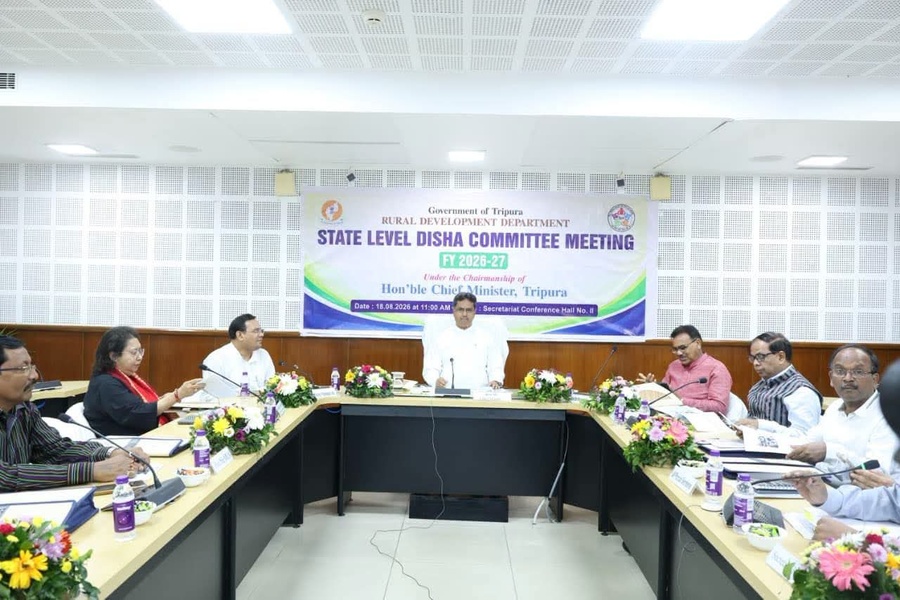
Tripura Chief Minister Dr. Manik Saha has called for closer coordination between the administration and elected representatives to ensure that development projects are completed on time and government schemes deliver tangible benefits to people at the grassroots level.
Speaking at the State-level DISHA Committee meeting for 2026-27 in Agartala on Tuesday, Saha stressed the importance of transparency, regular monitoring and prompt action in addressing issues emerging at the field level.
The Chief Minister noted that most decisions taken at the previous DISHA meeting had been implemented and urged officials to sustain the progress through periodic reviews. He said regular interaction between officials and public representatives would help identify gaps, improve accountability and ensure quicker solutions to public grievances.
He also directed officials to make welfare schemes more accessible and understandable to beneficiaries. Reviewing healthcare initiatives, including Ayushman Bharat PM-JAY and the Chief Minister Jan Arogya Yojana, he suggested displaying clear information about covered treatments and surgical procedures at hospitals. He also proposed using QR codes so that patients and their families can access scheme-related details through mobile phones.
Officials informed the meeting that 16,66,870 Ayushman cards had been issued in the state, covering 7,00,922 families under AB-PMJAY. Under the Chief Minister Jan Arogya Yojana, 6,36,527 cards have been issued, covering 2,86,820 families.
The Chief Minister reviewed several social and rural development programmes, including PMAY-G, Jal Jeevan Mission, Swachh Bharat Mission-Gramin, agriculture, roads, education and skill development.
According to officials, 99 per cent of the 3.76 lakh houses sanctioned under PMAY-G have been completed. Under the Jal Jeevan Mission, 6,24,477 rural households, or 83.17 per cent, have received functional tap water connections.
Dr Saha also stressed the need to improve Anganwadi infrastructure, strengthen measures against child marriage and encourage women-led self-help groups to expand production. He called for greater cleanliness, waste management and hygienic conditions in government offices as part of the broader Swachh Bharat initiative.