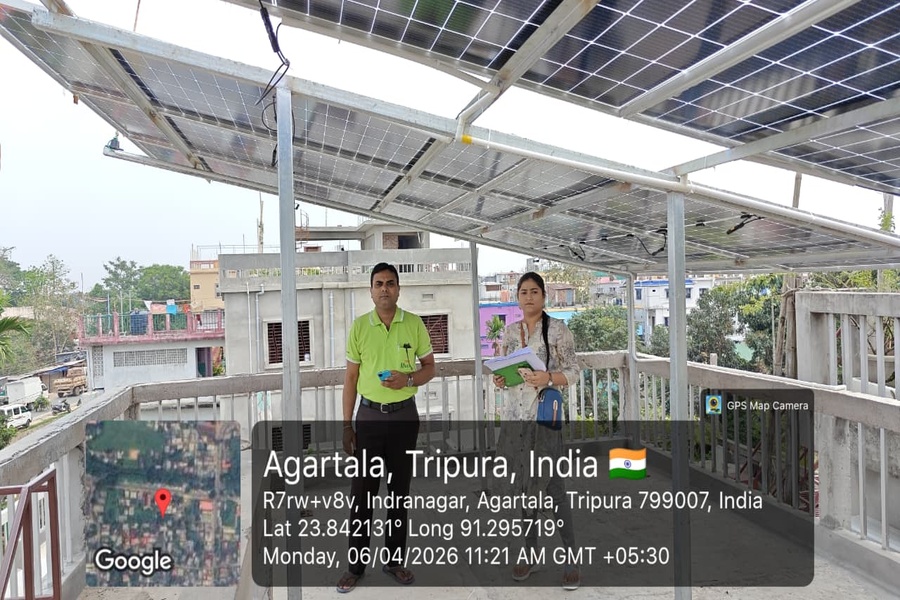
Energy in Tripura is no longer something generated far away and delivered to homes—it is increasingly being created right where people live. Rooftops that once sat idle are now turning into active sources of power, marking a decisive shift in how the state produces and consumes electricity.
This transition has reached a significant milestone. Under the PM Surya Ghar Muft Bijli Yojana, Tripura has surpassed 10 megawatts of solar power generation. But the number tells only part of the story. What’s really unfolding is a broader change—one where ordinary citizens are stepping into the role of energy producers, not just consumers.
TSECL Managing Director Biswajit Basu highlighted that 2,933 households have already installed rooftop solar systems, effectively converting their homes into mini power units. Together, they have pushed total generation beyond the 10 MW mark. What’s even more promising is the pipeline—over 18,000 registrations under the scheme suggest that this momentum is only going to accelerate.
Power Secretary Abhishek Singh, IAS, sees this as an early but important step. The initiative is now being driven in mission mode, with a clear focus on expanding its footprint across every district and neighborhood. The immediate goal is ambitious but achievable—scaling up to 50 MW in the coming phase.
For Power Minister Ratan Lal Nath, this moment carries deeper significance. With natural gas resources presenting limitations, the shift toward solar energy is not just strategic—it’s necessary. He described the development as a turning point, one that sets Tripura on the path toward greater energy self-reliance. Acknowledging the role of engineers, field staff, and participating consumers, he emphasized that this progress is a shared achievement.
The idea is simple but powerful: let rooftops work. By installing solar panels, households can eliminate electricity bills and even generate surplus power that can be sold back to the grid. In effect, electricity is no longer just a cost—it is becoming an income stream.
The economics are already making sense for many. A 1 kW rooftop system can generate around 100 units of electricity per month, sufficient for an average household. With government subsidies significantly reducing upfront costs—over 20 crore already disbursed among 2,397 beneficiaries—the model is gaining traction quickly.
Adoption patterns show that Agartala is leading from the front, with the highest number of installations in TSECL’s Circle-1. Other districts are steadily joining in, reflecting a growing statewide acceptance of rooftop solar as a practical and beneficial solution.
To keep the momentum going, the administration has stepped up outreach efforts. Registration camps are being organized at power sub-divisions, while a dedicated control room at TSECL’s corporate office in Agartala is providing real-time assistance and support to interested consumers.