In a significant achievement in neonatal healthcare, doctors at Agartala Government Medical College and Govind Ballabh Pant Hospital (AGMC & GBPH) have successfully operated on a newborn girl suffering from a rare congenital defect, saving her life through timely diagnosis and specialised surgical treatment.
The baby was diagnosed with tracheo-oesophageal fistula (TEF), a congenital condition in which an abnormal connection develops between the food pipe and the windpipe. The surgery was performed on October 7, 2026, when the infant was just two days old.
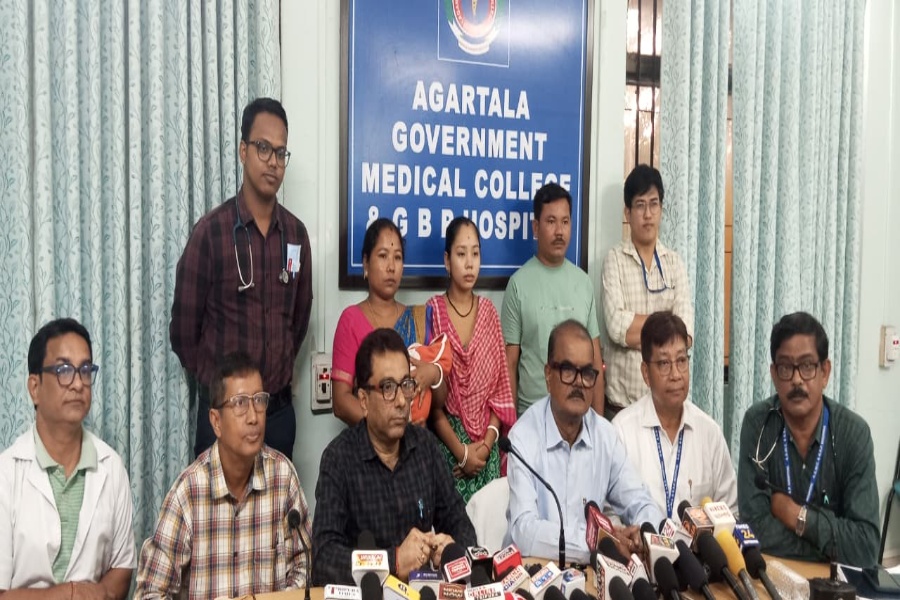
The details were shared at a joint press conference attended by GBP Hospital Medical Superintendent Dr Bidhan Goswami, AGMC Principal Dr Tapan Majumder, senior paediatrician Dr Sanjib Debbarma and Deputy Medical Superintendent Dr Kanak Chowdhury.
According to the doctors, the newborn, whose parents are residents of Gabtali under the P.R. Bari police station area of South Tripura, was brought to AGMC and GBPH from a private clinic around midnight on October 5 in a critical condition.
Soon after birth, the infant developed difficulty swallowing, excessive frothing from the mouth and gradually worsening breathing problems. Following her arrival at the hospital, she was immediately admitted to the Neonatal Intensive Care Unit (NICU) under the Department of Paediatrics.
Under the supervision of Dr Sribas Das, Associate Professor and Unit In-charge of the Paediatrics Department, the medical team initiated emergency measures to stabilise the baby. Clinical examinations and a chest X-ray raised suspicion of TEF, prompting doctors to prepare for urgent surgical intervention.
The operation was conducted under the leadership of Dr Kanak Narayan Bhattacharya, Consultant in Cardiothoracic and Vascular Surgery (CTVS) at AGMC and GBPH. The procedure involved a right-sided thoracotomy followed by surgical repair of the tracheo-oesophageal fistula. Cardiac anaesthesiologists Dr Rimjhim Chakma and Dr Manimoy Debbarma assisted in the operation.
Following the surgery, the baby remained under close observation in the NICU. As her condition improved, feeding was gradually resumed through a tube. After seven days, the feeding tube was removed, allowing the infant to begin breastfeeding normally.
After 12 days of intensive care and continuous medical supervision, the newborn was shifted to the neonatal ward. Hospital authorities said that she is now stable and healthy, staying with her mother and breastfeeding without difficulty. Her discharge is expected shortly.
The successful operation reflects the capabilities of the medical team at AGMC and GBPH in handling complex neonatal surgical emergencies. It also highlights the importance of early detection, prompt intervention and specialised medical care in saving the lives of newborns with critical congenital conditions.
The entire treatment, including the surgery and hospital care, was provided free of cost under the Janani Shishu Suraksha Karyakram (JSSK), a government initiative that aims to ensure access to free healthcare services for mothers and newborns. As a result, the family did not have to bear any out-of-pocket medical expenses.