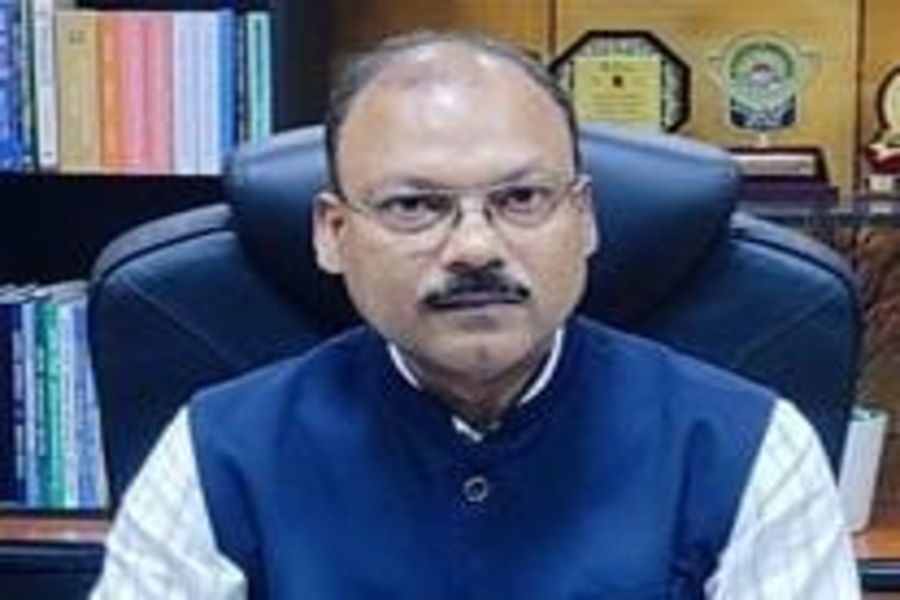
Tripura University is set to adopt a research-driven approach to improve its academic standing at the national level, with Vice-Chancellor Prof. Debabrata Das laying emphasis on innovation, technology-enabled education, industry collaboration and research focused on the Northeast.
Addressing faculty members, researchers, officials, employees and students at an event at the Maharaja Bir Bikram Auditorium, Prof. Das outlined his vision for the university and called for a shift from conventional degree-oriented education towards an institution that contributes to research, innovation and knowledge creation.
“Universities do not merely prepare for the future; they create the future,” Prof. Das said, stressing that education, research, innovation and social responsibility would have to move together.
Research, he said, would remain a strategic priority. The university's objective would not simply be to increase the number of research papers but to encourage high-quality research, competitive research grants, interdisciplinary projects, patents, consultancy and technology transfer.
Among the areas identified for greater attention are artificial intelligence, machine learning, cyber security, biotechnology, healthcare, climate change, sustainability, data analytics and the Indian knowledge system.
The Vice-Chancellor also wants the university to develop research programmes that address the specific needs and opportunities of the Northeast. Biodiversity, forest and water-resource management, sustainable agriculture, renewable energy, climate change and disaster management could emerge as important areas of research, he said.
The university would also encourage systematic research into indigenous knowledge, local languages, traditions, culture, traditional healthcare practices and medicinal plants. The idea, Prof. Das said, was to preserve local knowledge while subjecting it to scientific research and giving it wider recognition.
The focus on research is in line with Prof. Das's priorities since taking charge as the university's Vice-Chancellor last month. He had earlier said that improving teaching, learning and research, along with enhancing students' skills and employability, would be among his key objectives.
Prof. Das also called for a change in the classroom. The university would move towards student-centric and outcome-based learning, with greater emphasis on project work, practical training, interdisciplinary education and research-oriented learning.
Technology, however, would not replace teachers, he said. Faculty members would have to perform multiple roles — as teachers, mentors, researchers and innovators — in an increasingly technology-driven education system.
Students, meanwhile, would be encouraged to participate more actively in research and innovation, entrepreneurship, community service, cultural activities, sports and environmental programmes.
The university is also looking to expand its academic network through collaborations with IITs, IISERs, IISc, central and State universities, national laboratories, government agencies, industries, start-ups and international institutions.
Such partnerships, Prof. Das said, could provide opportunities for joint research, faculty and student exchanges, collaborative publications, consultancy and technology development.
The university's Central Library is also proposed to be developed as a modern, technology-enabled research and knowledge-support centre. Greater use of technology in administrative processes is part of the broader plan to improve institutional efficiency.
The roadmap comes soon after the appointment of Prof. Das as the university's 11th permanent Vice-Chancellor. The Ministry of Education appointed him to the post for a five-year term after the position remained vacant for nearly a year. He had earlier served as an adviser to the Higher Education Department of the Assam government and as Vice-Chancellor of Assam Rajiv Gandhi University of Cooperative Management.
The university's leadership has also received a push for greater research excellence. During his meeting with Prof. Das after the latter assumed office, Tripura Governor Indra Sena Reddy Nallu stressed high-quality research, innovation, academic excellence and faster recruitment to vacant teaching and non-teaching posts.
Prof. Das has called upon teachers, researchers, employees and students to work together towards the national objective of building a developed India by 2047.
The proposed approach seeks to combine Tripura University's regional responsibilities with a wider national ambition — to strengthen its position as a centre of research, innovation and higher learning in the Northeast. The university's official website currently lists Prof. Das as Vice-Chancellor.