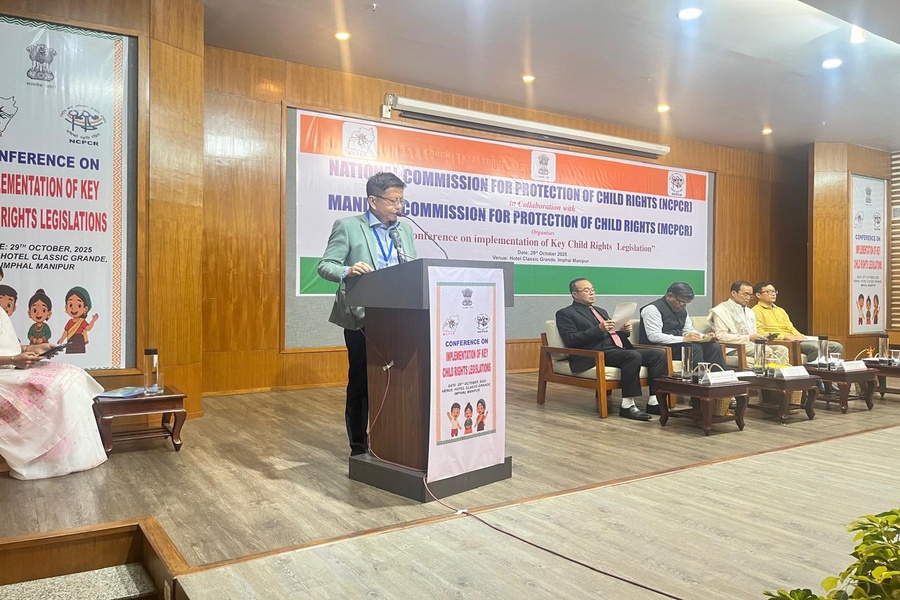
The National Commission for Protection of Child Rights (NCPCR), in collaboration with the Manipur Commission for Protection of Child Rights (MCPCR), successfully organised a State-Level Conference on “Gaps and Challenges in Implementation of Key Child Rights Legislations” at the Imperial Hall, Classic Grande, Imphal.
The one-day deliberation brought together senior government officials, members of the judiciary, police personnel, academia, and representatives from civil society, child-care institutions, and educational establishments.
The conference focused on identifying implementation gaps and actionable solutions under key child protection frameworks, including the Juvenile Justice (Care and Protection of Children) Act, 2015, the Protection of Children from Sexual Offences (POCSO) Act, 2012, and the Manual on Safety and Security of Children in Schools.
Delivering the keynote address, Dr. Sanjeev Sharma, Member Secretary, NCPCR, emphasised that child rights cases are not mere statistics but real stories of children and families. “The lives of our citizens and the future of our country depend on the actions taken by government officials,” he stated. Dr. Sharma reiterated that both the Central and State Governments are committed to protecting every child’s rights and urged all stakeholders to work collectively to realise this vision.
He underscored the importance of awareness creation among officials through training programs, among citizens via media, and among key functionaries through conferences and workshops.
Dr. Sharma also highlighted NCPCR’s recent achievements, noting that in the last six months, the Commission has disposed of around 26,000 cases, rescued over 2,300 children, and repatriated over 1,000 children to their home district child-care institutions. He further informed that the NCPCR has inducted the latest technology for improved case management and shared plans to address children’s mental health issues, develop an AI tool to combat Child Sexual Abuse Material (CSAM), and design new strategies to tackle challenges in implementing child rights legislations.
Citing the success of NCPCR’s “Sugar Board Initiative,” which has been appreciated by the Hon’ble Prime Minister, Dr. Sharma urged the Manipur SCPCR to implement the same initiative across schools in the state.
Shri Keishiem Pradip Kumar, Chairperson, MCPCR, highlighted the plight of children affected by displacement in Manipur, noting that the state currently houses a large number of Internally Displaced Persons (IDPs), including many children who have silently suffered losses. He shared that the MCPCR has been focusing on addressing mental health crises, school dropouts, and child labour issues in IDP relief camps.
He mentioned the successful conduct of seven mental health camps and psychosocial clinics, stressing that the response has been community-driven. Shri Kumar also referred to the role of Mission Vatsalya, a scheme of the Ministry of Women and Child Development (MWCD), Government of India, in supporting IDP children in Manipur.
He called upon schools, cultural bodies, and other institutions to come forward to protect children from trafficking, early marriage, abuse, suicide, cyberbullying, and substance abuse. Shri Kumar also discussed the impact of Artificial Intelligence on child education and learning, and appealed to the Government of Manipur to expedite the implementation of the long-awaited State Child Protection Policy.