
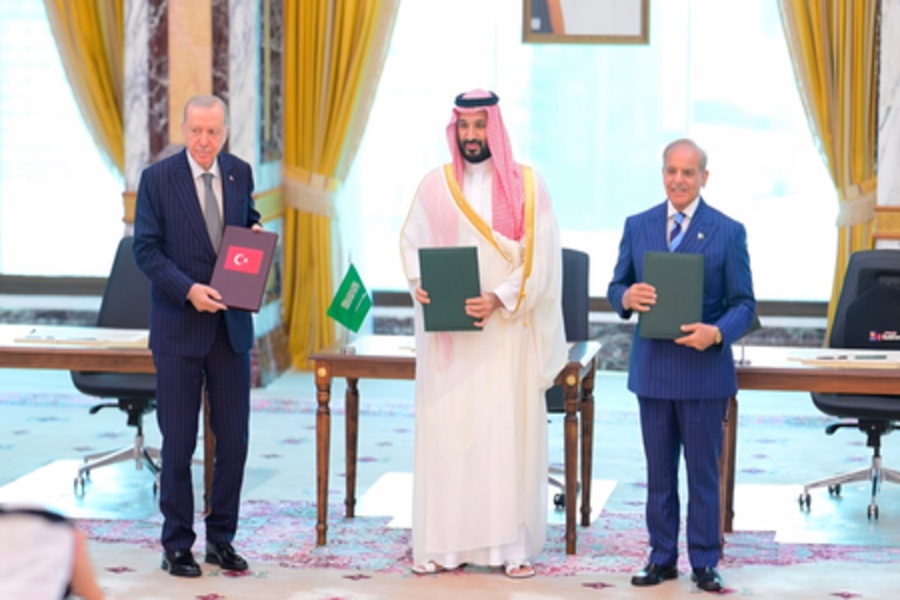
The first major test of the Mecca Joint Defence Agreement between Saudi Arabia, Pakistan and Türkiye has raised questions over how the three countries would respond to an actual military threat, after recent Houthi attacks on Saudi territory triggered no immediate military intervention by either Pakistan or Türkiye.
Saudi Arabia, Pakistan and Türkiye signed the agreement in Mecca on August 7, pledging to strengthen collective security and defence cooperation. The pact stipulates that an armed attack against any one of the three countries would be regarded as an attack against all three.
The issue came into focus after Houthi forces launched missile and drone attacks against Saudi targets earlier this month. The attacks reportedly targeted cities and critical infrastructure, prompting concerns over the practical implications of the newly signed defence arrangement.
Pakistan subsequently reaffirmed its commitment to the agreement. However, on September 10, Pakistani Foreign Ministry spokesperson Sajjad Haider Khan said Islamabad was not discussing any immediate military response under the pact, while maintaining that Pakistan would act under the agreement if the need arose.
The clarification followed media reports suggesting that Pakistan could consider air strikes against Houthi positions if requested by Saudi Arabia. Pakistani officials rejected those reports as an indication of any immediate military plan.
Türkiye, meanwhile, condemned the Houthi attacks. Turkish Foreign Minister Hakan Fidan later said Ankara was prepared to help meet Saudi Arabia's military needs under the defence agreement, including technical military assistance.
Germany-based political analyst Thiemo Rickenstorf, writing for Afghanistan-based Khaama Press, argued that the developments exposed limitations in the pact's practical enforcement. He described the agreement as largely symbolic and questioned whether Pakistan would ultimately engage militarily on Saudi Arabia's behalf.
The agreement was initially presented by its signatories as a framework for collective deterrence and closer defence cooperation rather than an alliance directed against any particular country. Pakistan's Foreign Ministry has also described the pact as defensive in nature and said it is not directed against any state.
Türkiye has similarly stressed that the agreement does not identify Iran or any other country as a common threat. Fidan has said that any response would depend on the circumstances and that a country facing an attack would need to request assistance and specify the type of support required.
The contrasting positions following the Houthi attacks have therefore prompted renewed debate over how the Mecca agreement would operate in practice. While all three countries continue to affirm their commitment to collective security, the nature and extent of any military response remain dependent on circumstances, requests for assistance and each country's strategic considerations.