India’s presidency of BRICS demonstrated New Delhi’s ability to bring together an increasingly diverse group of countries and build consensus on key global issues, analysts said at a roundtable discussion held in the national capital.
The experts said the successful conclusion of the 18th BRICS Summit under India’s chairmanship and the adoption of the Delhi Declaration reflected India’s diplomatic efforts amid a challenging geopolitical and geoeconomic environment.
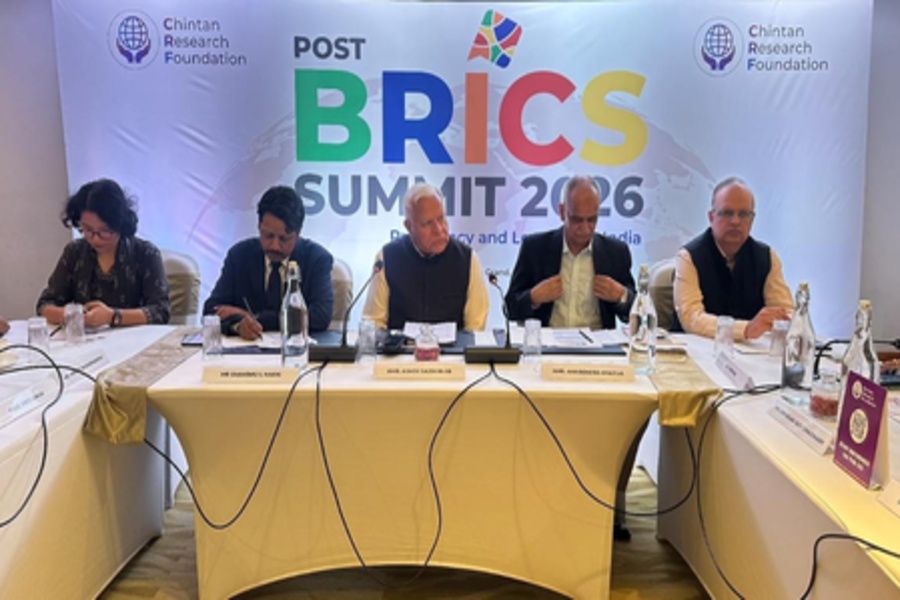
The observations were made during a roundtable titled “Post BRICS Summit 2026: Presidency and Lessons for India”, organised by the Chintan Research Foundation (CRF) three days after the summit concluded in New Delhi.
The discussion brought together diplomats, policymakers, academics, think-tank representatives and members of the strategic community to examine the key outcomes of India’s BRICS presidency and the future direction of the grouping.
Participants highlighted the consensus reached on the 2025 Pahalgam terror attack and the BRICS call for zero tolerance towards terrorism and disruption of terror financing as significant outcomes for India.
The discussions also examined the implications of BRICS expansion and the need to make the grouping more representative while maintaining a balanced approach rather than positioning it as an explicitly anti-Western platform.
Experts noted that India's presidency expanded the BRICS agenda beyond traditional areas such as geopolitics and de-dollarisation. Issues including trade resilience, institutional reform, security, healthcare, food and energy security, climate change, technology, entrepreneurship, women’s empowerment, critical minerals, artificial intelligence and education were brought into greater focus.
Delivering the keynote address, Shambhu L. Hakki, Joint Secretary (Multilateral Economic Relations and G20) in the Ministry of External Affairs and India’s G20 and BRICS Sous-Sherpa, outlined the challenges involved in hosting the summit and building consensus among member countries.
He said the Delhi Declaration reflected practical cooperation among developing countries. The participation of organisations and regional groupings such as the African Union, ASEAN, CELAC, GCC and BIMSTEC, he noted, added wider representation from the developing world.
The discussions also covered efforts to coordinate on global economic issues, institutional reforms and strengthening cooperation among countries of the Global South.
The role of the BRICS Troika in ensuring continuity between successive presidencies was also highlighted. Participants noted that heads of National Standardization Bodies discussed harmonising standards and reducing trade barriers.
Prime Minister Narendra Modi had also called on the expanded 11-member BRICS grouping to work on 10 proposals for global governance reforms and develop a unified BRICS Reform Roadmap ahead of the next summit in China.
Former diplomat Ambassador Ashok Sajjanhar said the implementation of the consensus reached at the summit would be crucial to ensuring that the Delhi Declaration translated into concrete outcomes.
He said India had sought to promote BRICS as a forum for cooperation rather than confrontation and noted growing international attention to issues such as connectivity, global supply chains and finance involving the Global South.
The roundtable also discussed the participation of the leaders of Russia, China and Iran and examined broader shifts in international perceptions of major powers.
De-dollarisation and the absence of a common BRICS currency were among the other issues discussed. Participants stressed the need to strengthen cross-border payment systems and the New Development Bank (NDB).
China’s proposal for a BRICS open-source artificial intelligence community also came under discussion, with participants expressing reservations about aspects of the proposal.
BRICS expansion remained another major theme. Participants discussed greater engagement with South Asian countries and examined the possible implications of future membership decisions, including discussions surrounding Pakistan and Malaysia. They also called for sustained economic engagement with partner countries such as Cuba and Bolivia.
The roundtable concluded with recommendations to accelerate work on cross-border payment mechanisms, the BRICS grain exchange and remote-sensing satellite constellations, besides strengthening the NDB.
Participants also identified areas such as wealth creation from waste as potential fields for practical cooperation among BRICS countries.
The experts said the broader significance of India’s BRICS presidency lay in its effort to convene a diverse grouping, build consensus on practical issues and strengthen BRICS as a representative platform for cooperation among countries of the Global South.