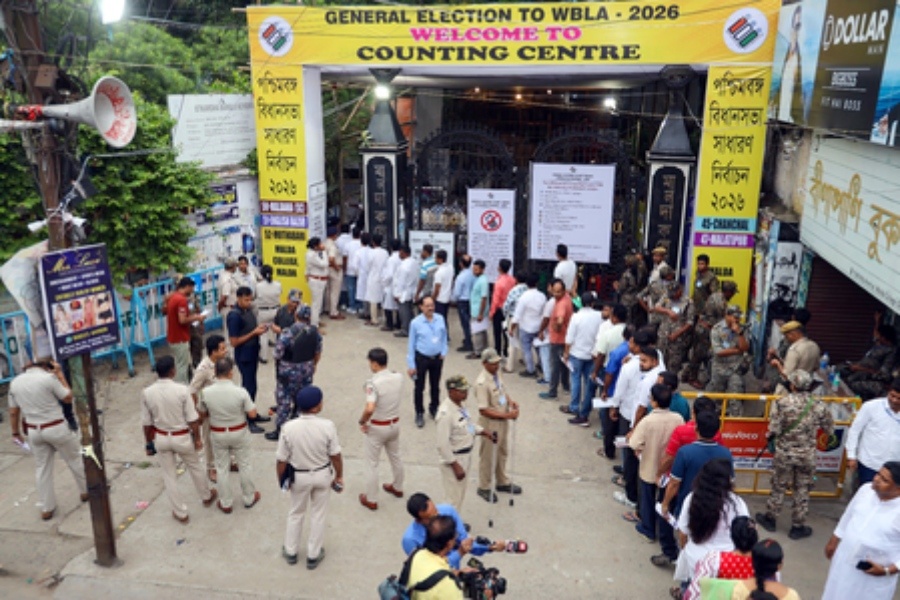
In the early stages of vote counting for the 2026 West Bengal Assembly elections, the contest between the ruling Trinamool Congress and the opposition Bharatiya Janata Party (BJP) appeared tightly contested, with the BJP holding a slight edge after the first two hours.
By 10 a.m., trends had emerged for 176 out of the state’s 293 constituencies. The BJP was leading in 90 seats, while the Trinamool Congress followed closely with leads in 82. The Indian National Congress and the Communist Party of India (Marxist) (CPI-M) were ahead in two seats each.
Congress candidates were leading in Malatipur and Mothabari, both located in the minority-dominated Malda district. Notably, Mausam Benazir Noor—a former Lok Sabha MP and ex-Rajya Sabha member who recently returned to Congress—was ahead in Malatipur.
Meanwhile, CPI-M candidates were leading in Jalangi and Domkal constituencies in Murshidabad district, another minority-dominated region.
Among prominent BJP leaders, Suvendu Adhikari was leading from Nandigram in East Midnapore, while Dilip Ghosh was ahead in Kharagpur (Sadar) in West Midnapore. Other BJP leaders in the lead included Agnimitra Paul from Asansol (Dakshin) and Swapan Dasgupta.
On the Trinamool side, some cabinet members were facing early setbacks. For instance, Sashi Panja, the state’s Minister for Women & Child Development and Social Welfare, was trailing slightly in the Shyampukur constituency.
As of that time, no trend was available from the high-profile Bhabanipur seat in South Kolkata, where Chief Minister Mamata Banerjee is contesting against Suvendu Adhikari.
Counting is being conducted in multiple rounds depending on constituency size, ranging from a minimum of 10 rounds to a maximum of 26.