
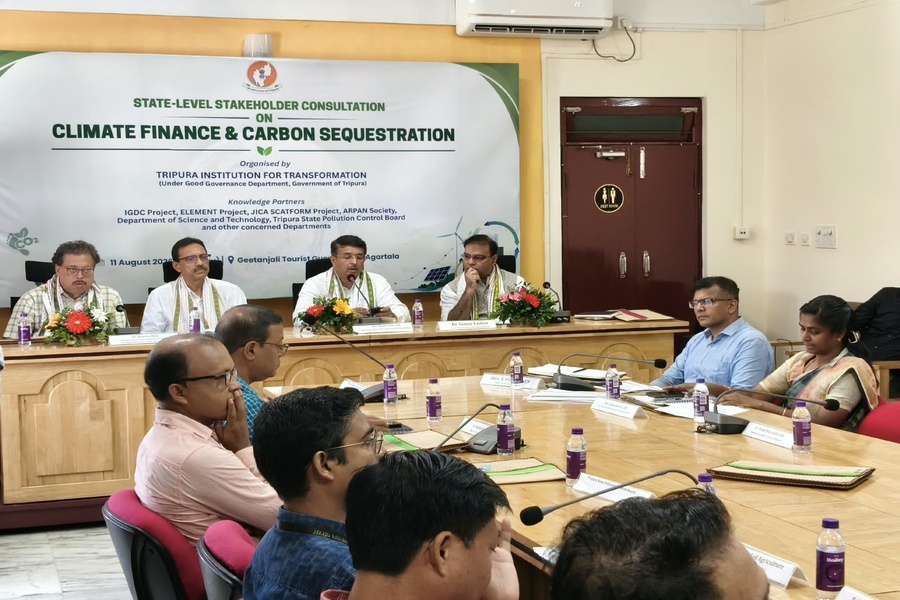
Tripura hosted its inaugural stakeholders' meeting on carbon sequestration and climate finance, bringing together 25 government departments, academic institutions, NABARD, and civil society organizations here today, targeting to explore potential opportunities and strategize effectively.
The event was organized by the Department of Good Governance in collaboration with ARPAN Society, Directorate of Biotechnology, IGDC Tripura project, and JICA. It was led by experts from the Climate Action Network of South Asia (CANSA).
Kiran Gitte, Secretary to Chief Minister, initiated the discussion by emphasizing Tripura's strengths in accessing the adaptation fund and the benefits of carbon sequestration. He also highlighted the preparations underway for the upcoming launch of the Carbon Credit Trading Scheme (CCTS).
NITI Aayog has pledged its support to Tripura in this initiative, recognizing the state's potential. The state government is committed to moving towards a green economy to mitigate the impacts of climate change.
P S Banerjee, OSD to the Chief Minister, highlighted the climate vulnerabilities faced by Tripura, including seasonal cycle changes, irregular rainfall patterns, and rising temperatures. He emphasized the urgency of robust activities in response to the challenges and to leverage the climate finance options.
Dr Biswendu Bhattacharjee, a climate activist and noted environment journalist, emphasized that revenue generated from carbon credit sales can be directed towards forest conservation, community development, biodiversity efforts, and support for rural livelihoods and green job opportunities by the initiative.
“Tripura's advocacy for a Green Bonus from the 15th Finance Commission in 2017 and the state's strong reiteration of the carbon trading demand in the last NEC meeting by Chief Minister Dr Manik Saha, nearly a decade later, which indicated the seriousness of the government,” he attributed.
Experts Dr Jayanta Basu and Dr Sanjoy Baishst discussed Tripura’s climate vulnerability and adaptation strategies, focusing on accessing climate funds for community development, livelihood enhancement, green job creation, and land management, in addition to carbon trading processes.
Dr Basu underlined Tripura's significant contribution to the global carbon credit market due to its lack of polluting industries, while emphasizing India's aim for its Integrated Carbon Market to be internationally recognized by 2030.
Aejay Bandhyapadhya, Team Leader for Asia-Pacific Climate Change at the International Finance Corporation, and Tanusri Bhattacharjee, General Manager of NABARD Tripura, discussed financial support mechanisms for Tripura's green projects and how to access climate funds.