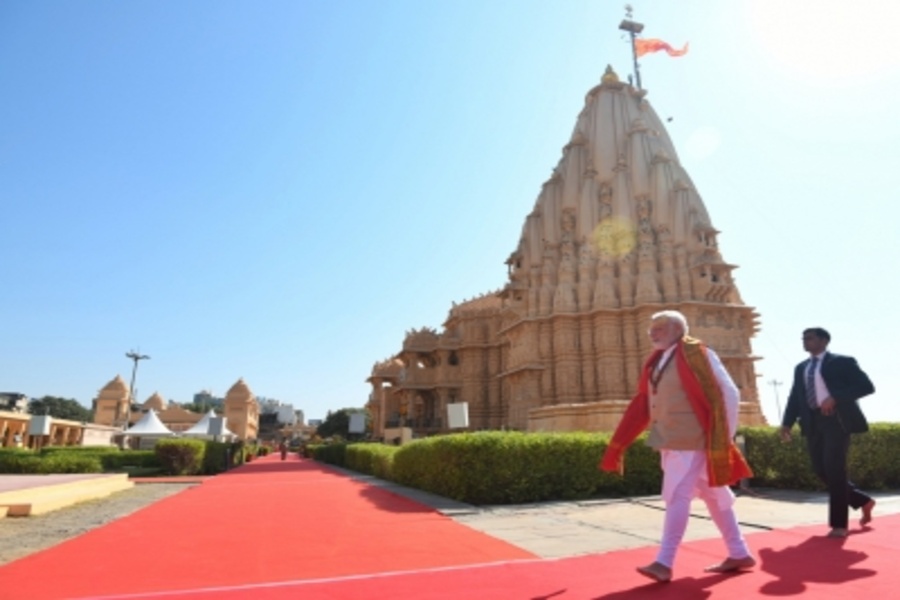
Prime Minister Narendra Modi on Monday reflected on the post-Independence restoration of the Somnath Temple, noting that India’s first Prime Minister, Jawaharlal Nehru, was not supportive of the initiative and opposed the association of constitutional authorities with the project.
In a blog post, PM Modi said the responsibility of rebuilding the historic Somnath Temple—destroyed during an invasion in 1026—was taken up by Sardar Vallabhbhai Patel after Independence. Patel’s visit to the temple site during Diwali in 1947, the Prime Minister wrote, left a deep impact on him and strengthened his resolve to reconstruct the shrine at its original location.
The restored temple was opened to devotees on May 11, 1951, in the presence of then President Dr Rajendra Prasad. PM Modi noted that Nehru had expressed discomfort with the government’s visible involvement in the event and felt that such participation could send an unfavourable message about India.
Although Sardar Patel did not live to witness the completion of the temple, PM Modi said his vision was realised through collective effort. Despite Nehru’s objections, President Rajendra Prasad chose to attend the inauguration, marking what PM Modi described as a defining moment in the nation’s history.
The Prime Minister also highlighted the role of K.M. Munshi, who worked closely with Sardar Patel and played a key role in the reconstruction. He praised Munshi’s book Somanatha: The Shrine Eternal, calling it a valuable account that reflects India’s enduring civilisational spirit.
PM Modi pointed out that the year 2026 will mark 1,000 years since the Somnath Temple was attacked, describing the temple as a lasting symbol of India’s resilience. He said its history demonstrates that while destruction may occur temporarily, faith and conviction have the power to endure and rebuild for generations.